Post
A catch
Save a catch to start your fishing logbook. You will be able to to share it with the community if yo want!
A fishing trip
Post an ad to go fishing with other fishermen
Save a catch to start your fishing logbook. You will be able to to share it with the community if yo want!
Post an ad to go fishing with other fishermen
My favorite cities
×Save a catch in your fishing logbook
Post an ad to meet and go fishing with other anglers
Unlock the fishing spots of Login, weather forecasts and many other services with the Premium Club.
10-day free trialAvec FishAndYou, vous pouvez créer votre propre concours de pêche, et gagner de l'argent.
Créer mon concours de pêcheThe zander fish belongs to the Percidae family. The Zander is a fish that can reach a length of 100 cm (maximum 130 cm) for a weight of 20 kg and an age of about fifteen years (maximum 20 years). Spawning takes place between April and August. Fertility is high with nearly 200,000 eggs/kg of female. It is caught from May to December. Its body is slender and fusiform. The head is elongated. The back is greenish grey and has slight dark vertical stripes. It has no transverse stripes and the flank is clear. The belly is whitish except in the male during the breeding season when it is darker. No thorns on the gill cover. Its two dorsal fins are separated. The first is spotted and thorny. The caudal fin has 17 soft rays. Its mouth is armed with many teeth and large "canines" that are visible when the animal is motionless due to breathing movements.
Fishing period : From May to December
Minimum size : 50 cm
Difficulty : 

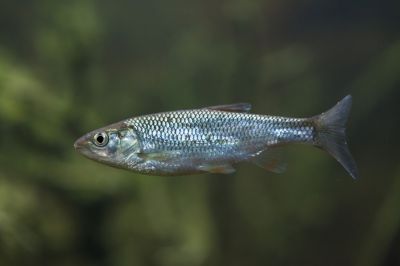
The Sunbleak fish belongs to the Cyprinidae family. The usual size of sunbleak is 4 to 6 cm for a weight of about ten grams. The largest individuals can reach 9 cm. Its lifespan is about 2 years. It breeds between May and July. It is prohibited to fish for the sunbleak in white water from October to March, but in mixed and calm waters it can be fished all year round. The Sunbleak has a tapered, laterally compressed body, like the common bleak with which it is often confused. However, its body is more robust and less high than that of the latter. Its head is small with eyes that are excessively large in relation to the size of the head. Its lower jaw is longer than its upper jaw, giving its mouth a forward and upward orientation, indicating a fish that feeds preferentially on the surface. The caudal fin of sunbleak is particularly indented, its dorsal fin fits well behind the pelvic fin insertions. The sunbleak has an olive-brown back, bluishly reflective sides and a silvery belly. Its fins are light grey.
Fishing period : From April to September in the white water and all
Minimum size : no restriction
Difficulty :
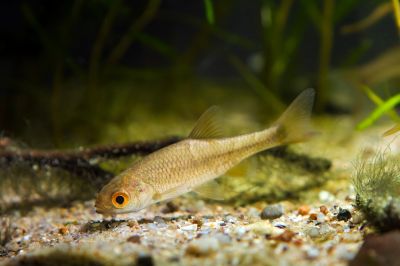
The Rudd fish belongs to the Cyprinidae family. The current size of the rudd fish is 15 to 30 cm for a weight of 0.5 to 1 kg. It can reach nearly 51 cm in height and weigh 2 kg. The rudd fish can live about 17 years. Egg laying is split and takes place from April to June. The female lays 100,000 to 200,000 eggs. Fishing for rudd is allowed all year round. It is easily identifiable by the diver: the silvery appearance of its body. A closer look at the position of the dorsal and ventral fins will then make the difference between the two species. If the ventral fins are placed further forward than the dorsal fin, it is the ratchet. The mouth, small, terminal, opens obliquely upwards. The back of the rattlesnake is brownish green, the sides and belly are silvery. The iris of the eyes is yellow with golden reflections. Dorsal, anal and pelvic fins are bright red in color.
Fishing period : All year
Minimum size : 15 cm
Difficulty :
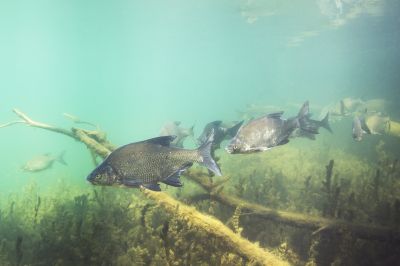
The Bronze bream belongs to the Cyprinidae Family. The current catch size varies between 30 and 50 cm, for a weight of 0.5 and 2.5 kg. Some individuals can reach a maximum height of 80 cm for a weight of 7 kg. It lives between 20 and 25 years. It reproduces between April and June and lay 100,000 to 300,000 eggs. The Bronze Bream can be fished all year round in 2nd category streams and is not hard to catch with the right bait. In Europe, there are 2 or 3 types of bream, 5 species and 2 subspecies. The Bronze bream has a very high and strong body flattened laterally. The bushy back, especially in older individuals, is characteristic of this fish. Its body is covered with large scales and mucus. The Bronze bream has a fairly small eye compared to the size of the muzzle. The mouth is small, oblique, barbless and protractile. The upper jaw protrudes beyond the lower jaw. Teeth are subject to seasonal replacement. The anal fin is very long and has 23-30 soft rays. On the other hand, the dorsal fin is short and inserted behind the pelvic fins. The caudal fin is very indented with the lower lobe longer than the upper lobe.
Fishing period : All year
Minimum size : 30 cm
Difficulty :
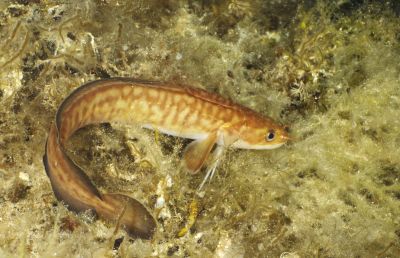
The Burbot fish belongs to the Lotidae family. The burbot can measure 30 to 120 cm and weigh up to 3 kg. It can live from 15 to 20 years. It breeds from December to March and can lay up to one million eggs. It can be fished all year round. The body is cylindrical, elongated, slightly compressed towards the tail, covered with small scales covered with a thick layer of mucus. The back is greenish brown or yellowish with darker mottling, with a gradation becoming lighter on the sides. The belly is yellowish white. The short, rounded pectoral fins, close to the head, overhang the ventral side with their first very elongated radius. The first dorsal fin is short, the second, very long, continues until the birth of the caudal, which is rounded. The lower jaw has a single long barbel and the nostrils have two fairly distant orifices, each with a small barbel. The mouth is wide, with many fine teeth.
Fishing period : All year
Minimum size : 50 cm
Difficulty :
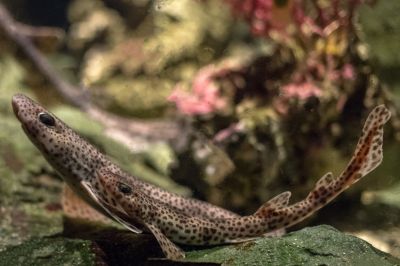
The Lesser Spotted Dogfish belongs to the Scyliorhinidae. It has a height of about 80 cm in length and a maximum weight of 5 kg. It can live up to 8 years. It breeds from November to July. The female lays about a hundred eggs. It is fished in winter. The lesser spotted dogfish is a small spotted shark with a rounded snout. The spots are small, numerous, brown to blackish-brown on a light beige to red background, the belly remains light. Five gill slits are located just behind the black and oval eyes. As with all species of the Scyliorhinidae family, the first dorsal fin D1 is located behind the pelvic fins; the second dorsal fin D2 is located just behind the anal fin. The distance between the 2 dorsal fins D1 and D2 is greater than the length of the base of the anal fin. The nasal valves are contiguous.
Fishing period : in Winter
Minimum size : No restriction
Difficulty :
The Bullhead fish belongs to the Ictaluridae family. This species generally measures 15 to 20 cm, but can reach a maximum of 45 cm for a weight of 2 kg. It can live up to 6 years. It breeds in May-June and lays up to 5000 eggs. It can be fished all year. It is a scaleless fish with bare, viscous skin. Its naked body is elongated and has thousands of sensory cells (electro-receptor cells) that are a particular feature of the species. He has a large flattened head, a very wide mouth with large lips and 8 barbels, 6 of which hang, and 2 are located behind the nostrils. Its pectoral fins have sharp spines that are dangerous. Similarly, its first dorsal fin has a sharp sting. It also has a short fat fin (between the dorsal and caudal fins). Its brown back is almost black or greenish brown, its sides lighter, its belly yellowish white.
Fishing period : All year
Minimum size : 20 cm
Difficulty :
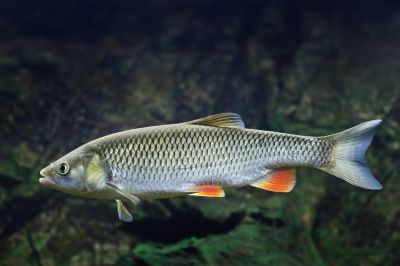
The chub fish belongs to the family of Cyprinidae. The common catch size of the chub fish varies from 15 to 30 cm, but it can reach 80 cm for a weight of 8 kg. The longevity is estimated at about ten years. The reproduction of the chub takes place between April and June. The female lays 20,000 to 100,000 eggs. It can be fished from July to Mars. The body is long and cylindrical with a terminal mouth, pointing upwards, with large lips. The big head has a flat forehead. The large, black-edged scales give it a reticulated appearance. The anal fin has a convex rear edge. The back and upper part of the head are greyish-green to brown in color; the flanks have silvery or even golden highlights; the belly is whitish. The fins are grey except for the bellies and the pale red anal fin.
Fishing period : From July to February
Minimum size : 15 cm
Difficulty :
The Bleak fish is a Cyprinidae. In general, its average size is 10 to 15 cm and its weight is 15 to 50 g. However, some individuals can reach up to 60 g for a size of 25 cm. The bleak has a lifespan of 6-7 years. The spawning period is between April and August. It can lay up to 7000 spawns. You can fish bleak from June to September. This fish swims quite fast and offers a little resistance during the catch. The bleak is a fish with an elongated body that is very compressed laterally, allowing it to have a high velocity. The upper jaw is shorter than the lower jaw. The mouth of the bleak is oriented upwards (above), a typical character of fish that seek their food on the surface. The caudal fin is strongly indented and the caudal peduncle is thin. The dorsal fin is inserted behind the pelvic fins and has a shorter base than the dorsal fin. Its name refers to the bright white color of its scales, which gives the bleak a metallic sheen. Its back is darker greenish-blue, its sides are silvery white and its fins are pale grey. During the breeding season, nuptial tubers appear on the backs and sides of males and their fins become orange.
Fishing period : June to September
Minimum size : 10 cm
Difficulty :
The Largemouth Black bass belongs to the Centrarchidae family. It has an average size of 50 to 70 cm for 4 kg. Its longevity is about 15 years. Spawning occurs from late spring to mid-summer. The number of eggs varies according to the size of the female, from 2000 to 14000 eggs. It is caught from March to October. Large-mouth black bass is a moderately large and robust fish. Its head is strong. Its terminal mouth is large, broad and oblique. The lower jaw is slightly prominent while the upper jaw extends to the back of the eye. The two dorsal fins are almost entirely separated. The first dorsal fin is rather low and has 10 spines. The second dorsal fin with a rounded shape is higher and has an average of 12 rays. Pelvic fins are short, rounded and have 1 spine and 5 soft rays. The pectoral fins are rather short, broad, rounded at the tip and have 13 to 15 rays. The dorsal side of the body varies from bright green to olive. The sides are pale green or golden green. There is a wide, uniform black lateral band that sometimes extends over the operculum and eye to the muzzle. The sides of the head vary from green to olive. The caudal is devoid of bright colors. The ventral side varies from milk white to yellow.
Fishing period : March to October
Minimum size : 30 cm
Difficulty :
7.6
10 am
Take out your rods! The fishes are here.
High
Medium
Low
The fishing forecast allows you to forecast your fishing trips and always go at the right time to the right place!
This is a score of 1 to 10 calculated city by city according to some forty criteria affecting fishing: moon, weather conditions, atmospheric pressure, sunrise / sunset. sun, tides, swell etc .